Kruger & Greater Kruger
South Africa's premier wildlife destination. The region combines Kruger National Park with adjoining private reserves and some of the country's finest safari lodges.
A country of extraordinary contrasts — breathtaking beauty, diverse cultures and unforgettable adventures, where Big Five safaris, spectacular coastlines, mountains and vineyards all sit within a single country.
Nine unique regions, eleven official languages, three thriving capital cities. South Africa is certainly one of the most unique places on earth.
South Africa is a remarkably diverse destination that combines world-class Big Five safaris with spectacular coastlines, mountains, vineyards, vibrant cities and rich cultural history — making it an excellent choice for both adventure and relaxation, often within the same trip. Few countries let you track lion and elephant in the morning and watch the sun set over Table Mountain the same week.
It is also a country where the landscape changes dramatically beneath you as you cross it — from the vast, wildlife-rich plains of the northeast and the rugged mountains of the interior to the vineyards, coastlines and cosmopolitan energy of the Cape. From the private airstrips scattered across Kruger's lodges to the vineyards of the Cape Winelands, South Africa's developed infrastructure makes it one of the most accessible — and rewarding — fly-in destinations on the continent.
A single country offers safari, mountains, coastline, desert, wine country and sophisticated cities.
Big Five, private reserves, national parks and internationally recognised conservation.
From Table Mountain and the Cape Peninsula to the Drakensberg and Lowveld.
A fascinating and complex history combined with extraordinary cultural diversity.
Excellent international connections and a well-developed tourism and aviation infrastructure.
South Africa's top destinations span an extraordinary range of landscape and experience.
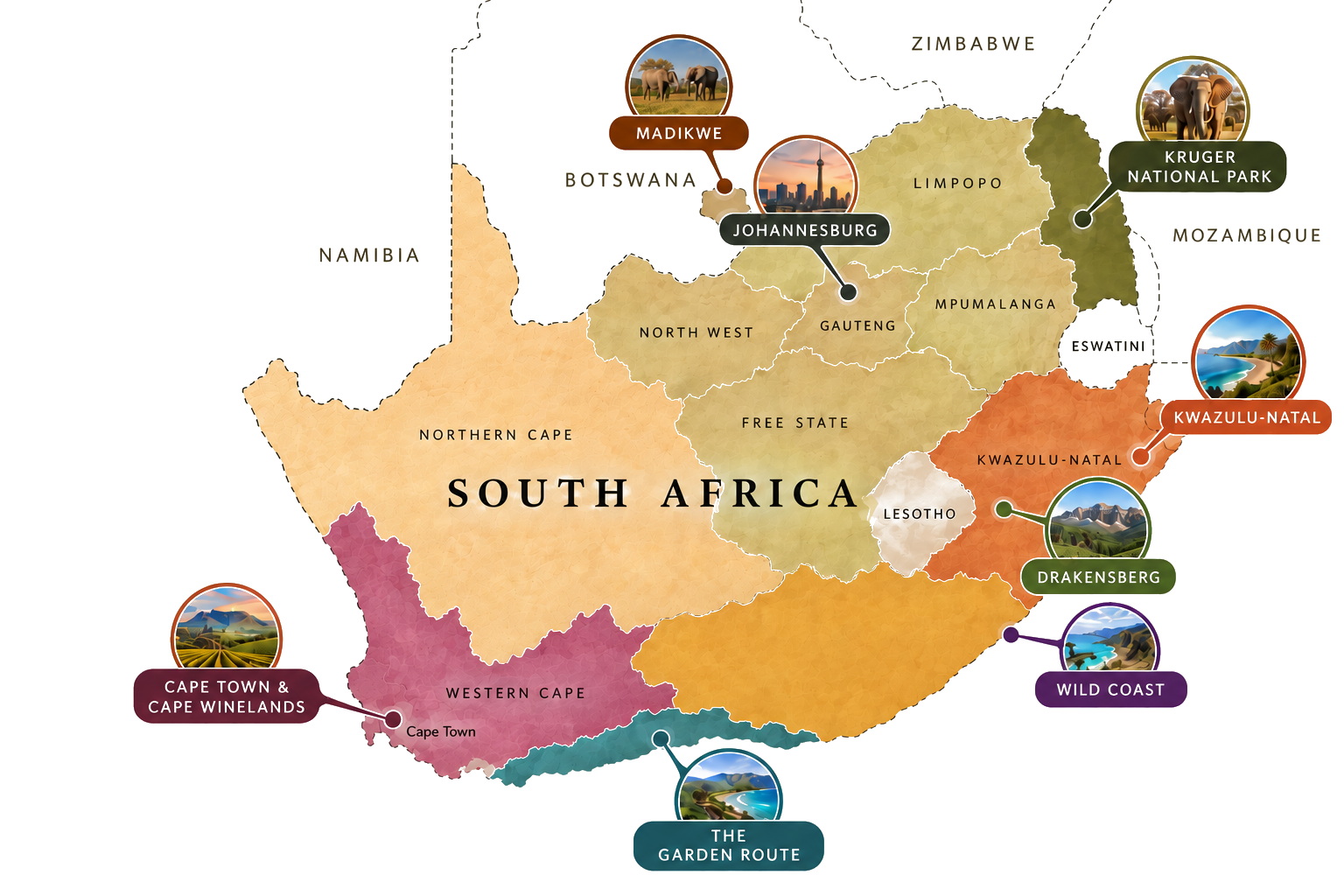
South Africa's premier wildlife destination. The region combines Kruger National Park with adjoining private reserves and some of the country's finest safari lodges.
Table Mountain, the Atlantic coastline, and a cosmopolitan city where the mountains meet the sea — one of the most photographed skylines on earth.
Stellenbosch and Franschhoek's world-class wine estates — scenery, cuisine and wine in one region, a short flight from Cape Town.
A spectacular stretch of southern coastline combining forests, mountains, lagoons and beaches — particularly attractive for travellers seeking landscapes beyond the traditional safari.
A remote, undeveloped stretch of Eastern Cape shoreline — rolling green cliffs, shipwrecks and traditional Xhosa villages, largely untouched by mass tourism.
South Africa's highest mountain range, forming the dramatic edge of KwaZulu-Natal — sweeping escarpments, alpine trails and some of the country's most spectacular mountain flying.
A diverse region combining private wildlife reserves, mountains, coastline and important conservation areas. Its malaria-free safari reserves make it particularly attractive to families.
A region of wildlife, mountains, wetlands, beaches and history. KwaZulu-Natal offers an especially varied combination of safari and coastal experiences.
South Africa's largest city and an important gateway to the country's interior and safari regions — also a major commercial, cultural and aviation centre.
The ideal season depends on where you are going and what you want to experience.
| Region / Activity | Jan | Feb | Mar | Apr | May | Jun | Jul | Aug | Sep | Oct | Nov | Dec |
|---|---|---|---|---|---|---|---|---|---|---|---|---|
| Cape Town | ☀️ | ☀️ | ☀️ | ☀️ | 🌧 | 🌧 | 🌧 | 🌧 | ☀️ | ☀️ | ☀️ | ☀️ |
| Kruger | 🌧 | 🌧 | 🌧 | ☀️ | ☀️ | ☀️ | ☀️ | ☀️ | ☀️ | 🌦 | 🌧 | 🌧 |
| Whale Coast | 🐋 | 🐋 | 🐋 | |||||||||
| Hiking | 🥾 | 🥾 | 🥾 | 🥾 | 🥾 | 🥾 | ||||||
| Safari | 🐾 | 🐾 | 🐾 | 🐾 | 🐾 | 🐾 | 🐾 | |||||
| Wildlife Photography | 📷 | 📷 | 📷 | 📷 | ||||||||
| Flying | ✈️ | ✈️ | ✈️ | ✈️ | ✈️ | ✈️ | ✈️ | ✈️ | ✈️ | ✈️ | ✈️ | ✈️ |
April – October
November – March
June – November
March – May & September – November
June – September
All Year Round
South Africa's size and geographical diversity make aviation an exceptionally effective way to experience the country. For pilots, South Africa offers one of the most developed aviation environments in Africa — extensive controlled and uncontrolled airspace, major international airports, numerous private airstrips and excellent access to safari destinations. It also serves as an important gateway to Namibia, Botswana, Zimbabwe, Mozambique, Eswatini and Lesotho.
The experience changes considerably once you leave the major centres. The landscape opens up and road distances become significant — but the aircraft becomes more than a means of transport. It becomes the key to accessing the country.
South Africa's scale means that flying can make an enormous difference to the way a journey feels.
But the value of flying is not simply speed. It is access, and experience — the ability to experience the country's geographical contrasts in a way that few travellers ever do.
All operational information is available on the Pilot Corner, accessible once you've booked your expedition with Aero Savannah.
Table Mountain and the Cape Peninsula, the Garden Route coastline, the Drakensberg, the Great Escarpment, the Lowveld and the Kalahari provide remarkably varied scenery from the cockpit.
South Africa has an extensive network of airports, regional airfields and private strips, making general aviation a practical way to explore the country.
South Africa is a natural starting point for longer expeditions into Namibia, Botswana, Zimbabwe and neighbouring countries.
Private and bush airstrips bring you close to remote reserves, lodges and landscapes — a remote lodge becomes an accessible destination, opened up by nothing more than a grass airstrip.
Few countries offer so much variety within a single flying journey. A flight can begin among vineyards and mountains, follow a wild coastline, cross the vast interior plateau and finish on a bush strip in the African wilderness. In South Africa, the flight is not simply a way to reach the destination — it is part of the experience.
South Africa ranges from Atlantic and Indian Ocean coastlines and subtropical beaches to the high interior plateau, the Drakensberg mountains, the Kalahari and Northern Cape, and bushveld and semi-desert landscapes — creating a wide variety of flying environments within a single country.
A vast interior tableland averaging 1,200–1,800 metres in elevation, forming the geological backbone of the country and shaping temperature and flying conditions across the interior.
The dramatic edge where the interior plateau drops toward the coast, rising to its highest expression in the Drakensberg — a formidable natural barrier, and a spectacular one to fly along.
The high central plateau around Johannesburg and Pretoria, sitting above 1,500 metres. Thin air, afternoon thunderstorms in summer, and cold, clear winter mornings define flying here.
The warm bushveld east of the escarpment, home to Kruger National Park and the private reserves along its border — lower altitude, denser air, and exceptional game viewing.
Parallel mountain ranges folded by ancient tectonic forces around Cape Town and the Winelands, creating dramatic valleys, microclimates and some of the most scenic flying in the country.
A vast, thinly populated semi-arid expanse to the west, transitioning into true desert — big skies, long distances between airstrips, and a stark, beautiful emptiness from the air.
Two oceans meet off South Africa's coastline, each shaping a different climate — the cold Atlantic to the west, the warm Indian Ocean to the east — and two very different coastal flying experiences.
Located in the Southern Hemisphere, South Africa experiences seasons opposite to those of Europe and North America. For simplicity, the climate can be broadly described in terms of two main seasons: summer and winter. Climate conditions vary across the country due to its size, altitude, mountain ranges and contrasting ocean currents. Generally, much of the interior and eastern regions receive most of their rainfall during summer, while the Western Cape experiences predominantly winter rainfall. South Africa enjoys plenty of sunshine throughout the year — in summer, average daytime temperatures range from around 15°C (59°F) to 28°C (82°F), while winter days are generally mild, with average temperatures between 19°C and 23°C (66°F to 73°F).
| Region | General Climate | Rainfall Pattern | Character |
|---|---|---|---|
| Cape Town & Western Cape | Mediterranean | Mainly winter | Dry summers, wetter winters |
| Kruger & Lowveld | Subtropical | Mainly summer | Hot summers, dry winters |
| Johannesburg & Highveld | High-altitude | Mainly summer | Warm summers, cool winters |
| KwaZulu-Natal | Subtropical | Mainly summer | Warm and humid |
| Garden Route | Temperate | Year-round / variable | Mild and changeable |
| Northern Cape | Semi-arid to arid | Low and variable | Hot summers, cold nights |
The weather and climate system in South Africa can sound complex — but the team at Aero Savannah takes care of all of it. Every expedition includes full weather and route briefings, so you can take off with confidence, whatever the sky is doing. For pilots, this is part of what makes flying here both challenging and rewarding.
Three of our five signature journeys are built entirely around South Africa.
Fly above Blyde River Canyon, land beside the Big Five, and explore iconic Kruger National Park.
02 South AfricaLush forests, dramatic sea cliffs, untamed beaches. Trade the road for the sky and soar above the majestic coast.
03 South AfricaFrom the Mother City to the Karoo's primal heartbeat — where lions outrank the traffic and skies blaze at sunset.
Contact us today to begin planning your unique African safari experience.
Plan Your Expedition